
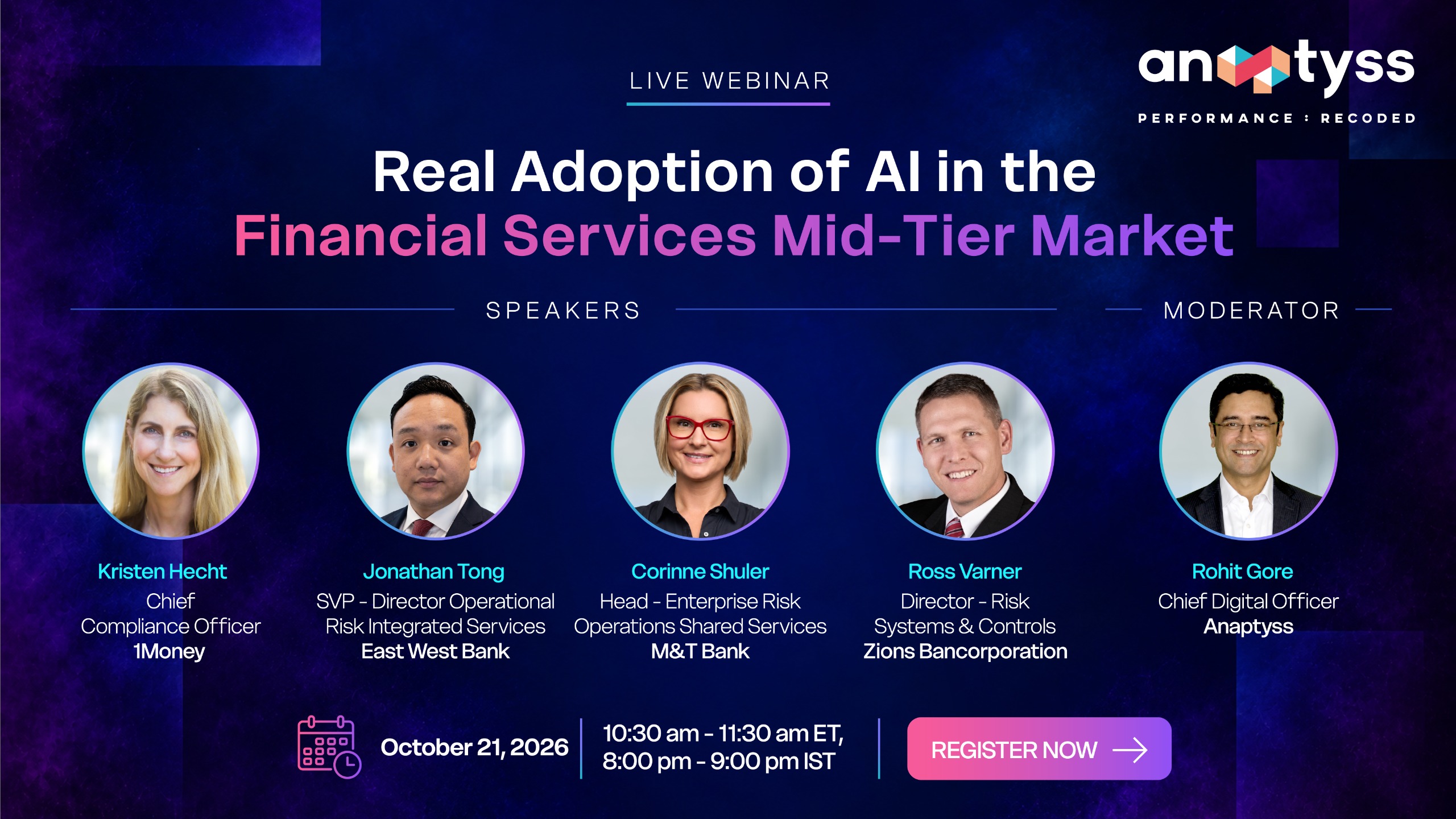
On October 21, 2026, Anaptyss hosted a live webinar on a question that is now a priority for many mid-sized financial institutions. What does real AI adoption look like for an organization that does not have the budget, headcount, or risk appetite of a global bank?
Moderated by Rohit Gore, Chief Digital Officer at Anaptyss, the session brought together four risk, compliance, and operations leaders from across the US banking sector. Their message was consistent. AI is here to stay, but the institutions that benefit most will be those that begin with a genuine business problem, test continuously, and keep people accountable for outcomes.
Meet the Panel
- Kristen Hecht, Chief Compliance Officer, 1Money
- Jonathan Tong, SVP, Director Operational Risk Integrated Services, East West Bank
- Corinne Shuler, Head, Enterprise Risk Operations Shared Services, M&T Bank
- Ross Varner, Director, Risk Systems & Controls, Zions Bancorporation
- Rohit Gore (moderator), Chief Digital Officer, Anaptyss
Why the Mid-Tier Market Requires Its Own AI Conversation
Rohit opened by noting that mid-sized institutions face a different set of choices from the largest banks. They must be more deliberate about where they invest their people, more disciplined about budgets, and more precise about risk appetite. Corinne Shuler added that as an institution grows and evolves, its workforce must adjust alongside it, and AI is now a part of that change.
Industry research supports this view. Bloomberg Intelligence, cited in Abrigo’s 2026 report on mid-tier banks, found that only 23 percent of financial institutions have reached enterprise-wide AI deployment, compared with 35 percent across all industries. The gap reflects the regulatory and risk-management requirements of the sector. Wolf & Company’s 2026 survey of 20 respondents at 17 community banks with $750 million to $25 billion in assets found that 70 percent have an AI adoption plan already underway, ranging from proofs of concept to scaled and governed programs. Yet 40 percent of respondents named the establishment of an AI strategy and roadmap as their top priority. American Banker’s 2026 AI Talent Shift survey also shows AI fluency rising across banks and credit unions.
Activity is high, but maturity remains uneven. This is the context in which the panelists spoke.
Key Takeaways from the Panel
-
Lead with a business problem, not the technology
Corinne Shuler encouraged leaders not to be drawn in by how “cool and fun” AI can be. In her view, enthusiasm does not always produce measurable results, and measurable results are what earn buy-in and trust. She advised identifying real pain points that affect real customers and employees, building AI into that specific problem, and using the measurable outcome as the foundation for the next pilot. When the benefit is clear and sustainable, she noted, adoption will spread quickly across the organization.
-
Continual testing and validation are essential
Kristen Hecht described continual testing as her guiding principle, particularly in advance of regulatory examinations. She personally verifies, almost daily, that the model’s output corresponds to the data entered, that the correct data is being processed, and that the results meet expectations. Corinne, who described herself as “risk born and bred,” agreed that testing and validation carry great weight. Kristen also observed that guiding AI toward the expected output is “not science,” but “more of an art.”
For US banks, that validation work now sits under SR 26-2, the model risk guidance the Federal Reserve, OCC and FDIC issued jointly on April 17, 2026, which supersedes and replaces SR 11-7.
-
Start narrow, but design for scale
Jonathan Tong advised institutions to select a meaningful process, begin with a narrow scope, and design for scalability from the outset. Equally important, he said, is to understand where a human remains accountable for the output.
-
Understand the regulatory and client impact before building
Because financial institutions are highly regulated, Jonathan stressed that accuracy carries significant consequences. Leaders should ask in advance what would happen if the output is not as expected, and whether a failure would materially affect the institution from a regulatory or client perspective. That understanding should shape the design of controls before any build begins.
-
Approach AI with optimism and a willingness to learn
Ross Varner urged institutions to take a “glass half full” view and to build the right structure around AI so that it benefits everyone. He cautioned that organizations that are not actively testing, trying, and learning will be among the first to be affected by the technology. His closing view was that the future is bright, and “brighter than some would say.”
-
The playbook is familiar
Rohit observed that the discussion sounded much like earlier technology waves. The same disciplines apply. Define the problem, control the risk, measure the result, and scale what works.
Five Questions to Guide Your Starting Point
Drawing on the panel’s advice, executives in mid-tier institutions can begin with five questions.
- What real problem are we solving, and who experiences it today?
- How will we measure success in a way that builds confidence with leadership?
- Where does a human remain accountable for the output?
- What is the regulatory or client impact if the output is incorrect?
- How will we test continually, and not only at launch?
What Mid-Tier Leaders Should Carry Forward
Corinne captured the spirit of the discussion well. AI is a capability of the future that is already here, and institutions that do not push for adoption risk losing relevance. Durable adoption, however, rests on measurable business outcomes, rigorous validation, and clear accountability rather than novelty.
Rohit closed by asking attendees to leave with one idea they can act on this week, and to observe whether it succeeds.
How Anaptyss Supports Your First Step
The panelists agreed on a common path. Select a meaningful process, define how success will be measured, keep a person accountable for the output, and validate continuously. Anaptyss helps financial institutions follow that path. As an AI-led technology and managed services company for regulated enterprises, we work with leadership teams to identify the right starting use case and scale it responsibly. If your institution is weighing where to begin, talk to our Consulting & Implementation team about a first use case.
We extend our sincere thanks to Kristen, Jonathan, Corinne, and Ross for their time and candor, and to everyone who joined and submitted questions.
Leave a message