

Private credit has moved from a niche allocation to a core pillar of institutional portfolios. Assets under management now exceed $2 trillion, and PwC’s base case projects the market could reach $3.4 trillion by 2030. That growth is a strength for the industry, but it is exposing a weakness that many lenders have not fully addressed. Operational infrastructure, not capital sourcing, has become the real determinant of performance. Firms that can institutionalize complex credit processes are pulling ahead. Firms still running private credit covenant management on spreadsheets and email threads are carrying a risk that does not show up on a balance sheet until it is too late.
Why Covenant Management Has Become a Front-Office Problem
For years, covenant tracking sat firmly in the back office, treated as an administrative task rather than a risk function. That assumption no longer holds. Regulators including the Bank of England, the FCA, the ECB, and APRA have sharpened their scrutiny of private markets. Limited Partners are asking for more transparency into portfolio health, largely because private credit carries a liquidity mismatch that public markets do not. In 2025, the bankruptcies of Tricolor and First Brands showed what happens when lenders cannot see a covenant breach or a liquidity crunch in real time. Manual systems simply were not built to catch problems fast enough. Fitch Ratings put the US private credit default rate at a record 6.0% for the 12 months through June 2026, a reminder that detection speed now matters as much as underwriting. As deal volume and deal complexity both rise, the gap between what a manual process can track and what a portfolio truly needs widens further.
The Hidden Risk in a Hyper-Competitive Lending Market
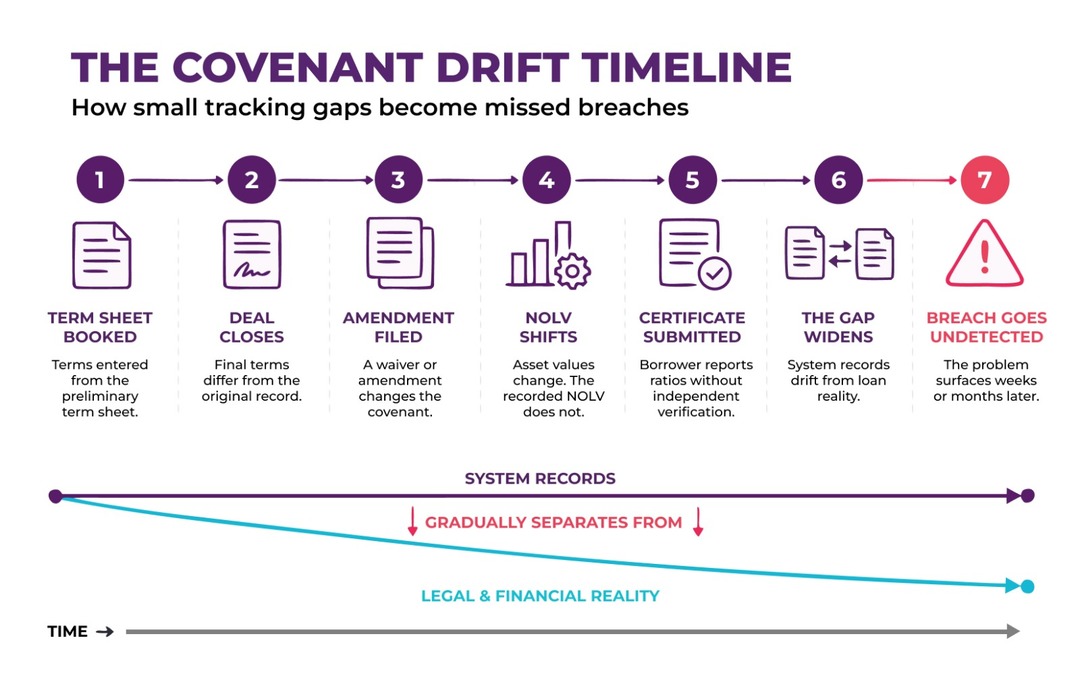
Yield compression has changed lender behavior over the past two years. Global direct lending spreads have narrowed steadily from the 700 bps range down toward the low 500s, and yields have followed a similar downward path. With large volumes of dry powder chasing deals, and sizable institutional commitments such as J.P. Morgan’s $50 billion allocation to the space, competition for borrowers has intensified. One consequence is the rise of covenant-lite structures, which now make up more than 80% of US leveraged loans and 21% of direct lending deals. A reported 70% decline in covenant breaches sounds like good news. It is worth reading more carefully. Weaker covenant structures and inconsistent monitoring mean fewer breaches are being detected, not that fewer are occurring. This is what the industry has started calling “covenant drift,” where the tracking record and the legal reality of a loan slowly move apart. Covenant drift tends to come from a few recurring sources.
- Static spreadsheet limits. Net Orderly Liquidation Value changes as inventory and appraisals change. A spreadsheet cell does not update itself, so the figure lenders are looking at is often already out of date.
- Booking and amendment gaps. Covenants get keyed in from preliminary term sheets instead of the final executed agreement, or an amendment gets filed but never makes it back into the tracking system.
- The validation gap. Many lenders still rely on borrower-submitted certificates for financial ratios and add-backs rather than independently verifying the numbers.
Building an Integrated Operating Model
Closing the gap between the tracking system and the legal reality of a loan starts with breaking down the silos between front, middle, and back office functions. A connected, single-source-of-truth model gives every team the same view of a deal at the same time.
This means bringing deal execution and covenant tracking calendars, settlement processing, middle-office reconciliation of items like Paid-in-Kind versus cash interest, and portfolio-wide monitoring of illiquid marks into one connected environment instead of separate systems that each hold a piece of the picture.
On the PIK point specifically, in a higher rate environment more borrowers choose Paid-in-Kind interest to preserve cash, which quietly builds principal over time if it is not reconciled carefully. Layering on credit assessment scorecards for default risk and private market valuation tools for illiquid marks gives lenders a more disciplined, methodical view of portfolios that are otherwise hard to price with confidence. This integrated foundation is what makes the next layer, cognitive automation, actually work at scale.
Where NLP and Managed Services Fit In
An integrated platform solves the visibility problem. It does not solve the capacity problem. Reading and interpreting dense legal documents at scale still takes time, and headcount does not scale as fast as deal volume does. This is where Natural Language Processing and human-in-the-loop review models are changing the economics of covenant management. CovenAce, for example, is built to extract covenant terms from legal prose and structure the data automatically.
| Efficiency Gain | Result |
| Processing speed | 80 to 85% faster than manual extraction |
| Operational cost | 70% reduction in overhead |
| Analyst review time | 90% reduction |
The Digital Knowledge Operations model pairs this technology with a managed service layer. One super-regional bank reached a 95% annual review completion rate across complex portfolios, including leveraged lending and automotive dealership exposures, using this model.
New Growth Areas Depend on the Same Foundation
As direct lending competition intensifies, more capital is moving into Asset-Backed Finance and credit secondaries. Goldman Sachs Asset Management’s of 434 insurance CIOs and CFOs found that a net 38% plan to increase allocations to asset-backed finance over the next 12 months, ahead of investment-grade private placements (35%) and senior direct lending (33%).2026 Global Insurance Survey Credit secondaries nearly doubled to about $20 billion in 2025, and Evercore reports alone$20.4 billion of volume in the first half of 2026, giving investors a liquidity option as redemption requests at non-traded BDCs climbed to an average of 10.3% of shares in the second quarter of 2026, according to Fitch Ratings data.
Ares raised $7.1 billion and Coller Capital raised $6.8 billion for dedicated credit secondaries strategies, and continuation vehicles from TPG Twin Brook and Crescent Capital point to the same trend. None of this works without accurate, current covenant data. A secondary buyer pricing a loan portfolio needs to know the real status of every covenant at the moment of the trade, not the status as it was recorded three months ago.
A 10-Step Roadmap for Proactive Covenant Monitoring
These are the operational moves separating lenders who catch problems early from those who find out after the damage is done.
- Track covenants at the borrower level against the actual deal structure, not a generic template.
- Run deviation analysis to catch gaps between system records and the executed legal documents.
- Track affirmative, negative, and event-based covenants together to capture the full risk picture.
- Retain historical data so past patterns inform future credit decisions.
- Use independent calculation and third-party verification instead of relying on borrower-submitted certificates alone.
- Standardize data ingestion with contextual NLP extraction to reduce manual entry errors.
- Connect middle-office tracking with back-office servicing so records do not conflict or duplicate.
- Set up real-time alerts for priority breaches so teams can act before a small issue grows.
- Build tamperproof audit trails for every override, waiver, and amendment for regulatory defensibility.
- Partner with a managed services provider for exception clearing and remediation support.
Firms that follow this roadmap are treating operational infrastructure as a growth engine rather than a cost center. Given how fast private credit is scaling, that shift is quickly becoming a baseline expectation from LPs and regulators alike, not a competitive edge.
Getting Ahead of the Next Covenant Breach
Private credit’s next phase of growth will not be won on sourcing alone. As portfolios get larger and more complex, the lenders who come out ahead will be the ones who can see a covenant breach the moment it happens, not weeks or months after a borrower’s finances have already deteriorated. That level of visibility does not come from a bigger team working the same spreadsheets harder.
It comes from connecting systems that used to sit apart, verifying data instead of taking it on faith, and using technology to handle the volume that manual processes were never built for. The firms already making this shift are not just reducing risk. They are building the kind of operational track record that LPs and regulators increasingly expect to see before they commit capital.
For lenders still relying on manual covenant tracking, the question is no longer whether to modernize, but how quickly they can close the gap before the next Tricolor or First Brands happens on their own book.
Frequently Asked Questions About Covenant Management
What is covenant drift in private credit?
Covenant drift is the gradual gap between what a lender’s tracking system records and the legal and financial reality of a loan. It builds when terms are booked from preliminary term sheets, amendments are not re-keyed, collateral values change, or borrower certificates go unverified, so breaches surface late.
Why are covenant-lite loans harder to monitor?
Covenant-lite structures remove most maintenance covenants, leaving fewer early warning triggers. Lenders then rely on incurrence tests, reporting covenants, and independent analysis of borrower financials to spot deterioration, which makes accurate extraction of the covenants that remain, and continuous monitoring of borrower data, more important.
How does NLP improve covenant management?
Natural language processing extracts covenant terms, thresholds, and definitions from credit agreements and amendments, then structures them for automated monitoring. Paired with human review of exceptions, it shortens booking time, reduces keying errors, and keeps tracking records aligned with the executed legal documents.
Leave a message