
Internal audit is shifting to continuous, AI-assisted assurance where risk is monitored in near real time. AI supports testing, evidence, and anomaly detection, while auditors stay in control through human-in-the-loop governance. ANA enables this within secure, client-controlled environments, meeting the governance requirements of regulated financial institutions.
Traditional internal audit was built for a slower moving risk environment, one defined by annual or semi-annual reviews, manual testing, and retrospective reporting. But in today’s enterprise landscape, where risks emerge and evolve in real time, point-in-time assurance models are no longer enough. Agentic AI represents the next evolution of internal audit: intelligent systems capable of sensing risk, initiating workflows, and executing assurance activities within human-defined governance boundaries. Unlike basic AI co-pilots that generate summaries or surface information on demand, these systems operate as digital teammates, enabling audit functions to move beyond reactive oversight toward continuous, intelligence-driven assurance.
From Periodic Audit to Continuous, AI-Assisted Control Assurance
To understand the shift enabled by Agentic AI, it helps to compare the traditional periodic audit model with the emerging AI-assisted approach that is transforming core audit and control assurance activities.
| Dimension | Traditional Internal Audit | AI-Assisted Control Assurance |
| Audit Model | Periodic, cycle-based reviews | Continuous, always-on assurance |
| Testing Approach | Sample-based testing | Full population analysis with AI assistance |
| Risk Detection | Retrospective identification of issues | Near real-time anomaly detection and escalation |
| Evidence Collection | Manual coordination of DRLs | AI-assisted generation and mapping of required evidence |
| Control Monitoring | Point-in-time assessment | Continuous control tracking and drift detection |
| Auditor Role | Execution-heavy and documentation-driven | Review, validation, and orchestration of AI-assisted workflows |
| Response Lag | Weeks or months after occurrence | Near real-time visibility into emerging risk |
Practical Use Cases for Continuous Assurance
Agentic AI is enabling a shift from periodic audit execution to AI-assisted, continuous control assurance. The focus is not automation alone, but improving coverage, speed, and consistency in core audit activities under human supervision.
1. Risk and Control Matrices (RCMs) in Minutes
AI-assisted systems can interpret process documentation, walkthrough notes, and policy artifacts to help identify risks, map controls, and define testing frequencies. This reduces manual effort in RCM preparation while improving standardization across audits.
2. Full Population Testing
Instead of relying on sample-based approaches, audit teams can evaluate 100% of transactions across key processes such as approvals, reconciliations, and user activity. This improves assurance coverage and reduces the likelihood of missed exceptions.
3. Automated Document Request Lists (DRLs)
AI-assisted workflows can generate structured DRLs based on control objectives and testing requirements, identifying the exact evidence needed for validation, including approvals, reconciliations, logs, and supporting artifacts.
4. Intelligent Anomaly Detection
Modern monitoring models can detect behavioral and transactional deviations that fall outside traditional rule-based thresholds. This includes unusual approval patterns, timing anomalies, or inconsistent user behavior that may indicate elevated risk.
5. The Audit Function That Never Sleeps
Continuous monitoring enables near real-time visibility into control environments, helping identify control drift and emerging risks earlier in the audit cycle and supporting faster, more targeted remediation.
Governance Boundaries for Agentic AI
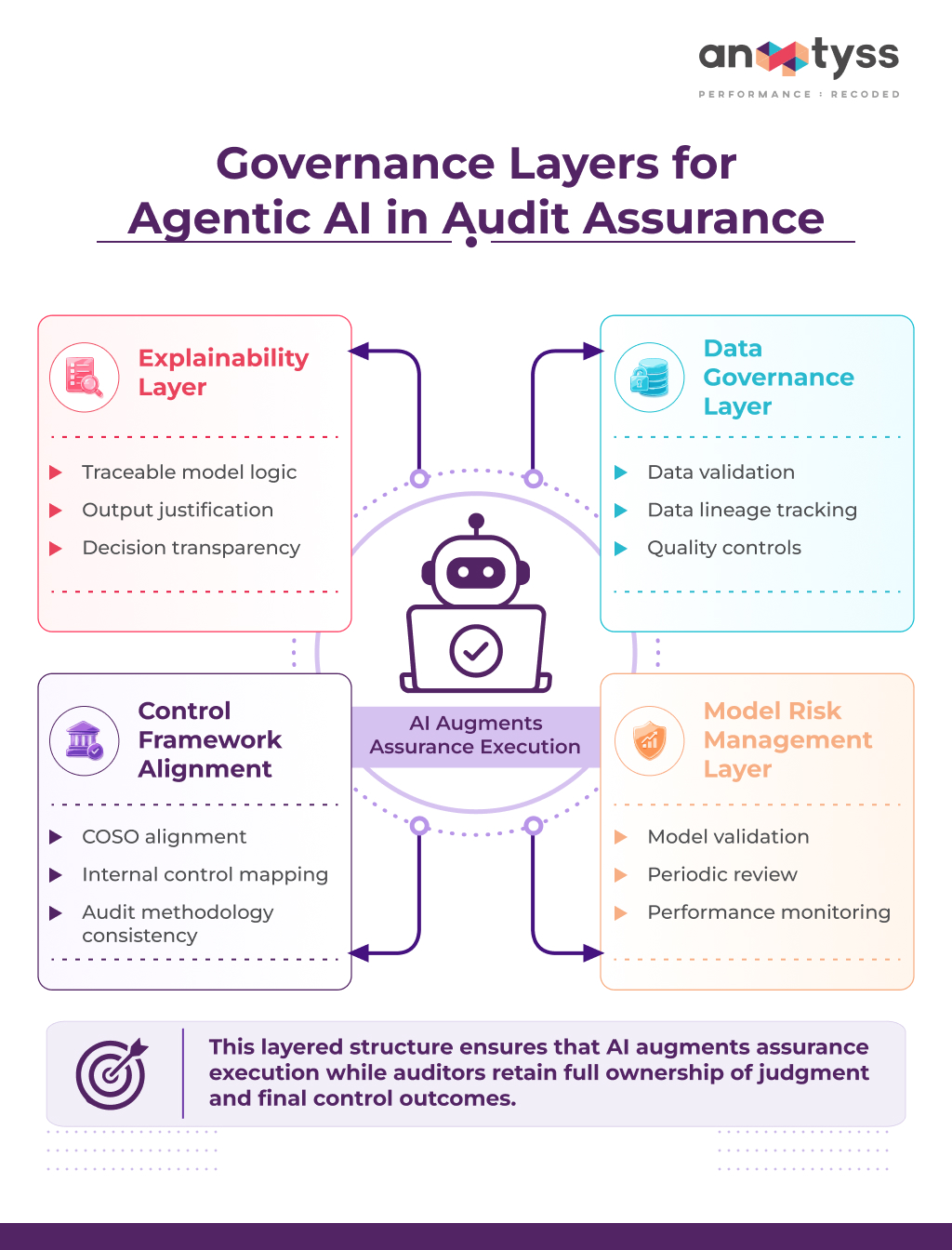
As AI scales in assurance, governance defines safe use. In regulated environments, human oversight remains essential for accountability and audit quality.
1. The Human-in-the-Loop Mandate
AI-assisted assurance systems can accelerate testing, monitoring, and analysis, but final judgment must remain with the auditor. Human-in-the-loop (HITL) governance ensures that risk interpretation, escalation decisions, and control conclusions remain subject to human review and accountability.
2. The Intern Analogy
Many organizations increasingly treat AI systems like digital interns, capable of processing information quickly, but still prone to hallucinations, context gaps, or flawed interpretations. Like any junior resource, AI outputs require supervision, validation, and auditor oversight before decisions are finalized.
3. The Explainability Requirement
In regulated industries, AI outputs must be explainable and traceable. Frameworks such as NIST AI RMF and ISO 42001 increasingly emphasize transparency, audit trails, and model governance, requiring organizations to document how systems reach conclusions and what data informs decision-making.
4. Governance Frameworks and COSO Alignment
Successful implementation requires AI governance to align with established internal control frameworks, such as COSO. This includes clear accountability structures, risk evaluation procedures, ethical usage guidelines, and continuous monitoring of model performance within assurance workflows.
5. Data Quality as a Risk Multiplier
AI systems amplify the quality of the data they consume. Incomplete, inconsistent, or poorly governed data can introduce systemic assurance risks at scale. Strong data governance, validation controls, and data quality monitoring therefore become foundational to responsible AI-assisted control assurance.
The Operational Reality of Agentic AI Implementation
Adopting AI-assisted assurance is not a plug-and-play shift. In regulated environments, success depends as much on governance, architecture, and workforce readiness as it does on the underlying technology.
1. Secure Deployment in Regulated Banking
For financial institutions, deployment design is often the primary constraint. Sensitive audit and customer data cannot sit outside controlled environments. This is driving a clear preference for secure, client-contained architectures where AI-assisted control assurance operates within enterprise infrastructure and remains subject to internal security and compliance oversight.
2. The Skills Gap
The challenge is less about tooling and more about interpretation. As audit becomes more AI-assisted, teams need stronger data literacy and judgment skills to validate outputs, challenge anomalies, and guide AI-driven workflows. The auditor’s role shifts toward supervision, review, and orchestration rather than execution alone.
3. A Crawl-Walk-Run Approach
Most organizations benefit from a phased adoption model. In the crawl phase, AI assists with documentation, DRL generation, and initial anomaly flagging all under close human review. The walk phase introduces AI-assisted testing across broader control populations, with auditors validating outputs before conclusions are drawn. In the run phase, continuous monitoring and near-real-time risk visibility become operational, supported by mature governance frameworks and data quality controls.
4. Economic Reality
Organizations that pair AI adoption with strong change management and governance maturity consistently achieve better audit scalability, faster cycle times, and improved risk visibility across the enterprise.
Conclusion – The Strategic Navigator
Internal audit is moving from retrospective reporting to continuous, AI-assisted assurance where risk is visible as it emerges rather than after the fact. For CAEs, the shift is less about automation and more about rethinking how assurance is delivered, with AI supporting execution and auditors retaining full accountability within clear human-in-the-loop governance. ANA is built for this model, an AI-assisted control assurance platform for regulated enterprises, designed to strengthen testing, streamline evidence workflows, and enable continuous assurance within client-controlled, secure environments.
To explore how AI-enabled control assurance can strengthen audit visibility and governance, connect with the ANA team at info@anaptyss.com.