
Traditional periodic audits create critical visibility gaps in banking risk management. Implementing AI-driven Continuous Control Monitoring (CCM) transforms these reactive processes into real-time, intelligent governance. This automated approach delivers proactive protection and enhanced visibility across cybersecurity, compliance, and operational domains.
In 2026, BFSI operations are moving faster than traditional risk systems were ever designed to handle. Real-time transactions, digital banking, and tighter regulations have changed the baseline. Yet many institutions still depend on periodic audits and sample-based control testing to track risk. That creates blind spots—issues often surface only after the damage is done.
The scale of the problem is also rising. Global cybercriminal activity is projected to reach $12.2 trillion annually by 2031, highlighting how embedded and expensive digital risk has become. At the same time, agentic AI in risk and fraud detection is emerging as a powerful capability, enabling organizations to identify anomalies, investigate threats, and respond to risks with greater speed and accuracy.
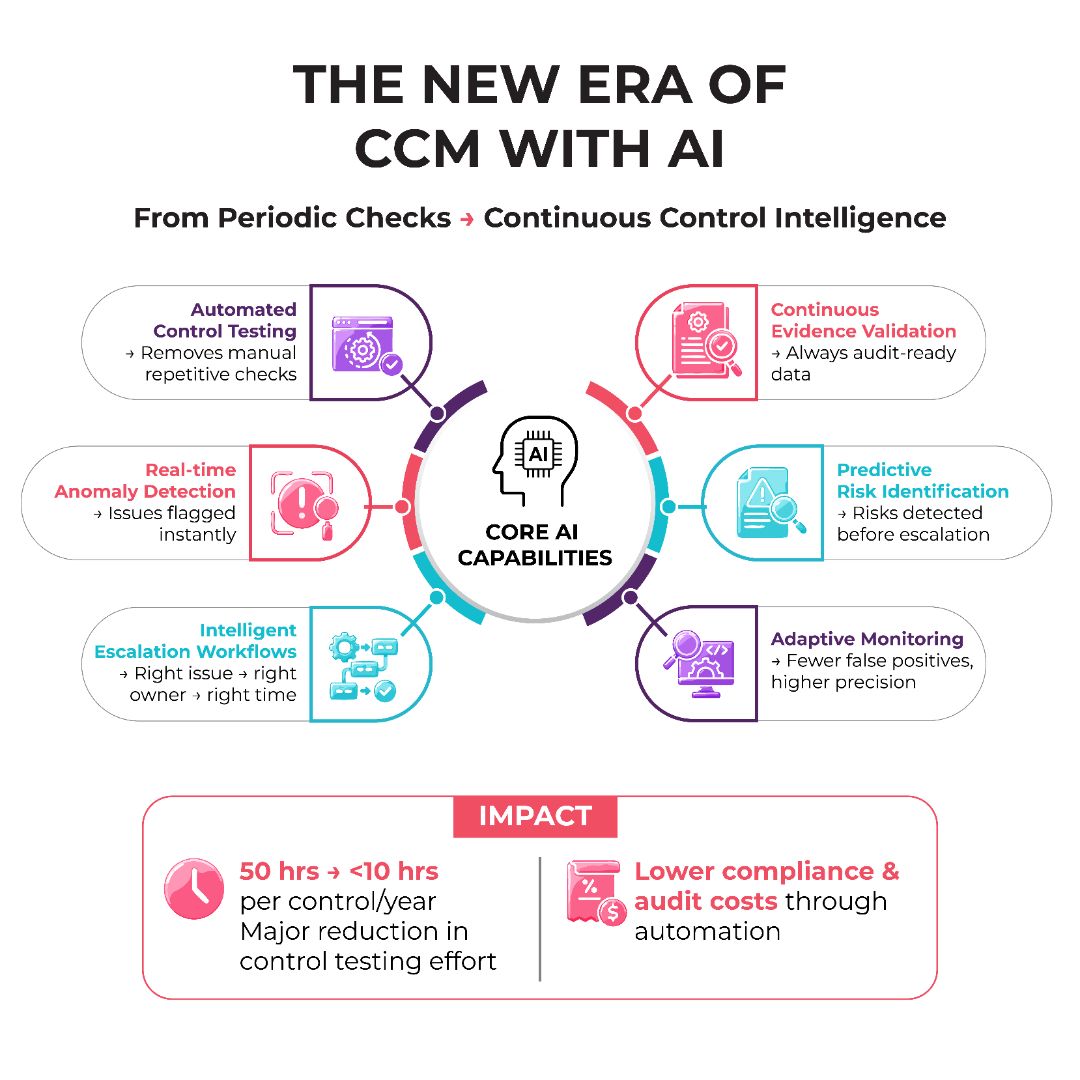
This is why Continuous Control Monitoring (CCM), powered by AI, is gaining ground—shifting control validation from periodic checks to continuous, real-time visibility.
Moving From Periodic Audits to Continuous Assurance
Traditional monitoring models are reactive by design. Controls are reviewed periodically, evidence is collected manually, and issues are often identified only after operational failures or audit cycles occur.
CCM changes this model completely by enabling continuous validation across transactions, workflows, approvals, user access environments, and compliance processes in real time.
| Traditional Monitoring | AI-Driven CCM |
| Periodic audits | Continuous monitoring |
| Sample-based testing | Full-data validation |
| Manual evidence collection | Automated evidence validation |
| Delayed issue detection | Real-time alerts |
| Reactive remediation | Predictive monitoring |
| High operational overhead | Intelligent automation |
As BFSI operations become more distributed and data-intensive, continuous visibility is rapidly becoming essential for effective governance.
High-Impact CCM Use Cases Across BFSI
The value of AI-driven CCM becomes especially visible in high-risk BFSI environments where operational resilience and governance visibility must coexist. Agentic AI in risk and fraud detection is further enhancing CCM by enabling autonomous monitoring and intelligent response workflows across financial operations.
AML and Transaction Monitoring
Continuous monitoring enables faster identification of suspicious transaction patterns, anomalies, compliance breaches, and risks through transaction monitoring for AML across high-volume financial environments.
User Access and Segregation of Duties (SoD)
AI-driven monitoring continuously validates access controls, privilege changes, and segregation conflicts to reduce internal risk exposure.
Fraud Detection
Real-time behavioral monitoring improves the ability to identify unusual operational or transactional activity before they escalate into material incidents
Audit Readiness and Compliance Visibility
Automated evidence collection and continuous validation improve documentation consistency, reporting accuracy, and examination readiness.
Operational Risk Monitoring
Continuous visibility across workflows and operational controls enables earlier identification of failures, process gaps, and governance exceptions.
Implementing CCM – Four Foundational Priorities
Effective Continuous Control Monitoring requires more than standalone automation—it demands the fusion of intelligent monitoring with domain expertise and scalable operational support.
This is enabled through DKO™ (Digital Knowledge Operations), which integrates intelligent digital solutions and deep BFSI consulting expertise into a unified governance framework.
To successfully implement AI-driven CCM, financial institutions should focus on four key areas:
Prioritize High-Risk Environments
Start with high-impact domains such as AML compliance, transaction monitoring, fraud detection, and user access controls to build early operational visibility and measurable risk reduction.
Leverage Real-Time Intelligence
Solutions such as Factum provide real-time analytics, dashboards, and monitoring visibility across compliance and operational environments, enabling faster issue detection and governance response.
Ensure Regulatory Alignment
CCM frameworks should support continuous reporting, audit readiness, and alignment with evolving regulatory expectations across banking and financial services environments. For a deeper look at how CCM helps mitigate compliance, cybersecurity, and operational risks, explore our Continuous Controls Monitoring whitepaper.
Adopt a Phased Deployment Model
Rather than attempting enterprise-wide transformation immediately, institutions should begin with targeted business functions, refine monitoring rules, and scale progressively across operational environments.
While AI significantly improves monitoring speed, scale, and anomaly detection, governance decisions and exception handling still require human expertise and operational judgment. The most effective CCM environments combine AI-driven automation with domain-led governance and structured decision-making.
The Future of Intelligent Governance
BFSI organizations are steadily moving toward continuous, intelligence-led governance, in which control visibility is embedded directly into operations rather than reviewed periodically.
AI-driven Continuous Control Monitoring (CCM) is accelerating this shift by improving real-time visibility, strengthening risk detection, and enabling faster, more consistent responses across control environments—resulting in stronger resilience and operational efficiency.
At Anaptyss, this transformation is already enabled through the DKO™ framework, supported by AI accelerators like ANA that bring real-time intelligence and visibility into enterprise control ecosystems. Its impact can be seen across complex control environments, including a U.S. regional bank’s RCSA transformation involving 200+ key control assessments.
To learn how Anaptyss can help modernize your control environment with AI-driven CCM, connect with us at info@anaptyss.com.