
Insurance operations are shifting from manual, fragmented workflows to AI-driven, intelligent systems. This blog explores how AI in insurance and managed digital services are transforming claims, improving efficiency, and enabling faster, more consistent decision-making.
As insurers face mounting pressure to reduce operational costs while improving claims responsiveness, traditional process-heavy operating models are becoming increasingly unsustainable. Differentiation in insurance no longer stems from pricing alone. It is increasingly defined by how efficiently and seamlessly an insurer operates.
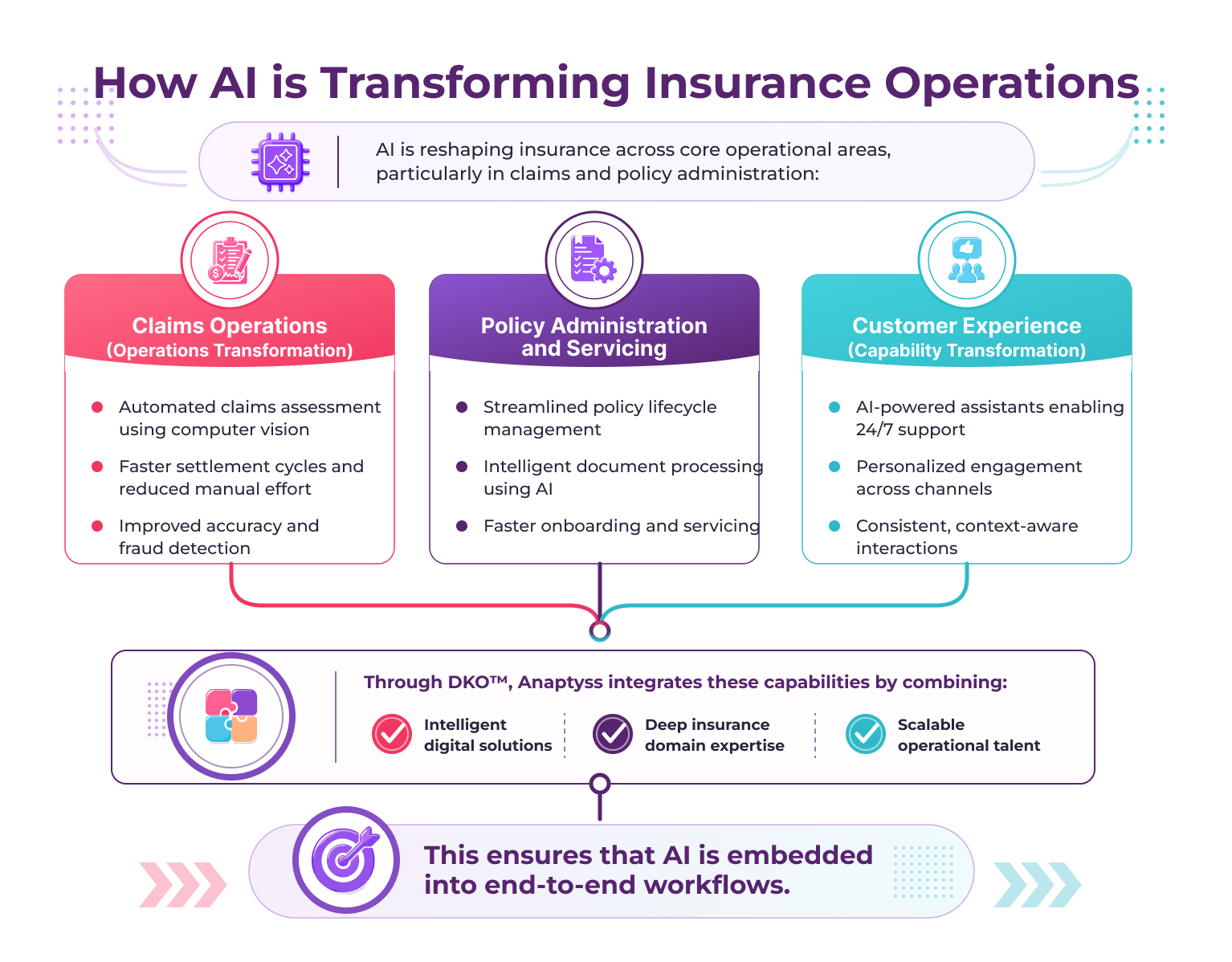
The AI in insurance industry is undergoing a structural shift from paper-heavy, manual processes to intelligent, automated workflows, and the future of insurance lies at the intersection of advanced Artificial Intelligence (AI) and insurance digital transformation. By combining domain expertise, digital solutions, and operational rigor, insurers are beginning to fundamentally reimagine how they serve policyholders and run their core functions.
Rising Customer Expectations for Speed, Personalization and Transparency
Customer expectations have changed faster than most insurance operations. Today’s policyholders expect experiences comparable to banking and e-commerce—fast, transparent, and digital-first. The traditional claims process, however, still struggles to meet these expectations. Delays, fragmented communication, and limited visibility into claim status continue to create friction at critical moments. This gap is not just experiential.
This directly affects retention and long-term customer value. According to a McKinsey analysis, the claims experience is the single most important driver of customer satisfaction and loyalty in insurance, making it a critical battleground for insurers. As expectations evolve, insurers are being pushed toward a model where claims are initiated, processed, and settled digitally, with minimal friction and near real-time responsiveness.
The Evolution of AI in Insurance toward Intelligent and Real-Time Decisioning
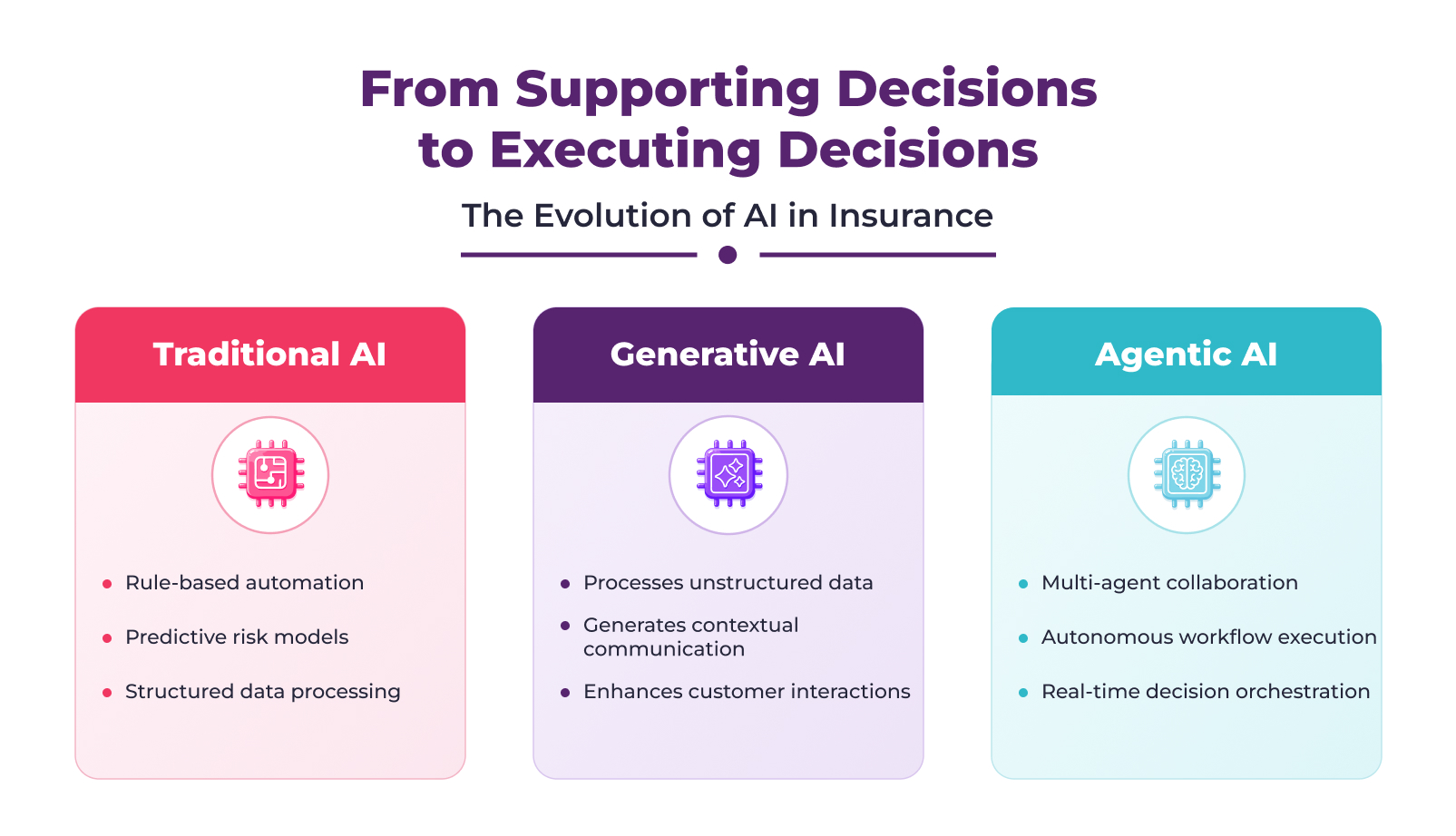
To meet these demands, insurers are turning to AI not as an incremental improvement, but as a core operational capability within the broader AI in insurance industry. Traditional systems are effective at handling structured inputs, but insurance workflows are inherently unstructured. Claims involve handwritten reports, images, documents, and contextual data that do not fit neatly into predefined templates.
This is where generative AI in insurance creates real value. Using Natural Language Processing and Computer Vision, AI systems can interpret and process this unstructured data in ways that were previously not scalable. According to McKinsey, AI could automate up to 25% of claims processing activities, significantly reducing manual effort and cycle times. In auto insurance specifically, this shift is most visible.
Damage assessment, which traditionally depended on physical inspections, can now begin at the moment of first notice of loss. Images submitted through mobile devices can be analyzed instantly, allowing early-stage decisions on severity, repairability, and next steps. The result is not just faster processing, but a fundamentally different operating model driven by AI in insurance underwriting and claims intelligence.
How AI Is Shifting Insurance from Reactive to Predictive Models
This shift reflects the broader future of insurance, where insurers move from reactive models to predictive, data-driven ecosystems powered by agentic AI in insurance.
| Traditional Insurance (Reactive) | AI-Driven Insurance (Predictive) |
| Assess → Process → Pay | Predict → Prevent → Personalize |
| Responds after an event occurs | Anticipates risks before they occur |
| Manual, process-heavy workflows | Automated, real-time decisioning |
| Limited visibility into risk | Continuous monitoring using live data |
| Static pricing models | Dynamic, behavior-based pricing |
AI in Fraud Detection and Risk Control
Fraud detection is another area where AI in insurance is reshaping operations. Rule-based systems have historically struggled to keep pace with evolving fraud patterns. AI, by contrast, can analyze large volumes of data across claims, identifying anomalies and patterns that would be difficult to detect manually.
The Coalition Against Insurance Fraud estimates that fraud costs the U.S. insurance industry over $300 billion annually — a figure that underscores the operational and financial stakes for insurers. Advances in image analysis further strengthen this capability. Systems can now detect inconsistencies in visual data, flag reused or manipulated images, and identify signs of pre-existing damage. This becomes especially important as insurers move toward digital-first, self-service claims journeys. The objective is not just faster claims processing but ensuring that speed does not come at the cost of control.
The Strategic Role of Managed Digital Services
While the potential of AI within the insurance industry is clear, operationalizing it at scale is significantly more complex.
Poor data quality, fragmented legacy systems, and limited specialized expertise continue to slow or derail insurance digital transformation initiatives. Gartner identifies poor data quality as one of the leading reasons AI programs fail to deliver measurable business outcomes.
Managed digital services now play a strategic role in helping insurers operationalize AI effectively across core business functions. The challenge is no longer deploying isolated automation tools, but integrating AI into complex operational environments while maintaining consistency, compliance, and scalability.
Anaptyss integrates AI directly into core insurance workflows while managing the operational complexity required for scale. This spans policy administration, claims processing, customer support, and data management, including areas such as AI in health insurance and broader risk ecosystems.
Successful transformation requires more than layering new technologies onto inefficient legacy processes. It requires redesigning workflows where AI, operations, and domain expertise function as a unified operational system. This enables insurers to move beyond fragmented automation initiatives toward integrated, end-to-end digital operations that improve efficiency, responsiveness, and customer experience.
Navigating Regulation with Explainable AI
As AI becomes more embedded in decision-making, regulatory expectations are evolving in parallel. Insurers are increasingly required to ensure that AI-driven decisions across claims, underwriting, pricing, and fraud detection remain transparent, auditable, and explainable. As AI adoption accelerates within the insurance industry, model risk management principles such as SR 11-7 are becoming increasingly relevant, particularly around governance, bias monitoring, decision traceability, and audit trail requirements. Regulatory expectations now extend beyond compliance alone, requiring insurers to balance AI autonomy with accountability and enterprise-grade oversight.
This makes Explainable AI a critical component of any transformation strategy within the future of insurance. Explainability enables insurers to clearly articulate how decisions are made, both for internal governance and for external stakeholders, including regulators and customers. It also enables systematic identification and mitigation of bias, ensuring that automation does not introduce unintended risk into outcomes.
Conclusion
Insurance operations are at an inflection point. What has historically been manual, fragmented, and resource-intensive is evolving into intelligent, integrated, and increasingly real-time operational frameworks. This shift reflects the growing role of AI in insurance and insurance digital transformation in aligning operational capabilities with changing customer expectations. AI and managed digital services are no longer optional enhancements.
They have become core to how insurers build resilience, efficiency, and competitive advantage in the future of insurance. Anaptyss helps insurers simplify and scale digital transformation by integrating domain expertise, advanced technologies, and operational excellence. From AI-driven claims processing to end-to-end managed services, we enable insurers to build more efficient, customer-centric, and resilient operations.
Ready to unlock efficiency and elevate your customer experience? Write to us at info@anaptyss.com